ICM : REF : ICM35484 : 1:35 : RUSSIAN (SOVIET) : Moskvitch-401-420A (1946-1954)






ICM REF :
35484
Manufacter : ICM.
EAN : 4823044405947.
Scale-Model release Date : 23.09.2019.
Model size (length x height) : 112 x 43 mm.
Box Size : 295 x 225 x 40 mm.
Number of details : 150.
Scale :
1:35
---
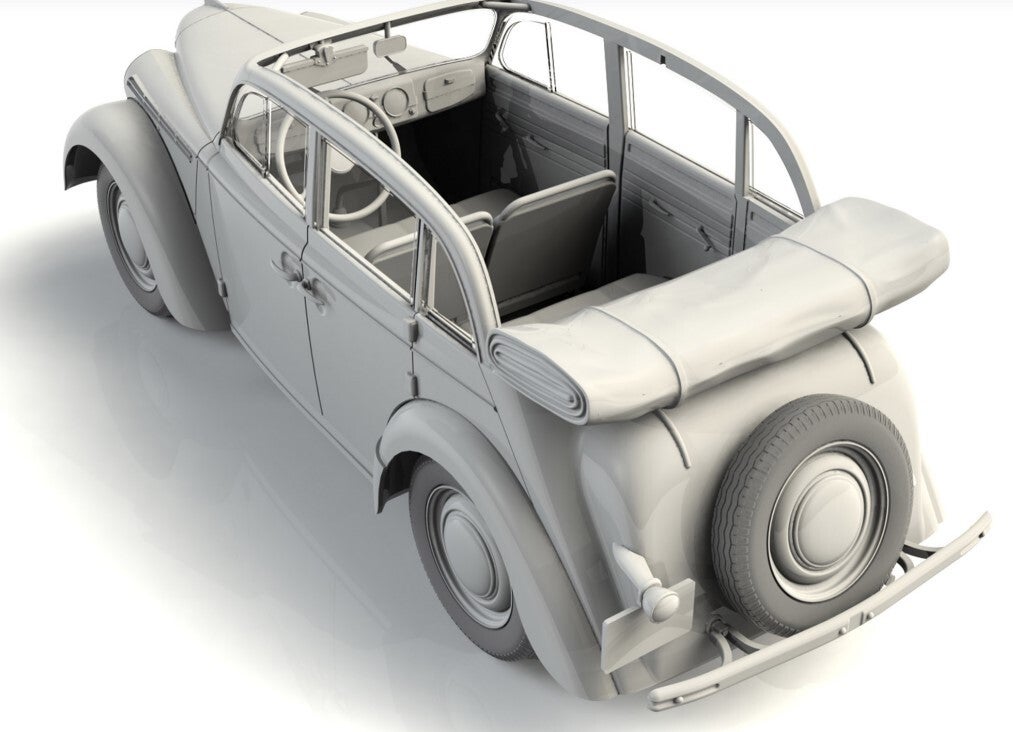
Moskvitch-401-420A :
Soviet Passenger Car
The passenger car Moskvitch-400 had been in producing in Moscow Plant of Small Cars (ZMA) since December 1946. It was an exact copy of the pre-war 4-door Opel Kadett K38 variant.
Moskvitch cars were produced in different types. Moskvitch-401-420A cars with 4-door cabriolet-sedan open bodies were less numerous. There were total produced 17742 cabriolets since 1949 till 1954.
---
Plus d'histoire :
La Moskvitch 400 est une automobile soviétique fabriquée de 1946 à 1954 et utilisant les chaînes de montage et l’outillage de l’Opel Kadett de 1940. La 401, version légèrement améliorée, a poursuivi sa carrière jusqu’en 1956.
L’Opel de l’est :
En 1945, l’armée rouge entre en Allemagne, qui capitule. L’usine moscovite MZMA va alors en profiter pour récupérer les plans et l’outillage de l’Opel Kadett, construite de 1936 à 1940. Les chaînes sont ainsi réinstallées à Moscou. La première Moskvitch d’après-guerre, la 400, sort le 4 décembre 1946, c’est la copie conforme de la Kadett 1940…
Motorisée par un 4 cylindres de 1 074 cm3 développant 23 ch, la Moskvitch atteint les 100 km/h dans les meilleures conditions. Sa ligne, vieille de 10 ans, ne détonne cependant pas face aux productions européennes de l’époque, comme la Renault Juvaquatre, la Skoda Popular ou la Morris Ten.
En 1947, la gamme s’enrichit de deux versions inédites : le break type 421 et la fourgonnette 422, tous deux à panneaux de carrosserie latéraux en bois, façon Ford Woody. En 1948, la berline découvrable 420 A fait son apparition.
La Moskvitch est malheureusement pénalisée par sa tenue de route, assez mauvaise malgré l’emploi d’une suspension à bras longitudinaux à l’avant et à ressorts à lames semi-elliptiques à l’arrière. Le système de freinage hydraulique n’est, quant à lui, pas tout à fait au point : il nécessite une forte pression sur la pédale, pour une efficacité laissant à désirer.
---
The Moskvitch 400 is a Soviet automobile manufactured from 1946 to 1954, using the assembly lines and tooling of the 1940 Opel Kadett. The 401, a slightly improved version, continued production until 1956.
The Opel of the East :
In 1945, the Red Army entered Germany, which then surrendered. The Moscow factory MZMA took advantage of this situation to acquire the plans and tooling of the Opel Kadett, built from 1936 to 1940. The assembly lines were thus reinstalled in Moscow. The first post-war Moskvitch, the 400, was released on December 4, 1946; it was a carbon copy of the 1940 Kadett…
Powered by a 1,074 cc four-cylinder engine producing 23 hp, the Moskvitch could reach 100 km/h in ideal conditions. Its design, though ten years old, didn't look out of place compared to other European cars of the time, such as the Renault Juvaquatre, the Skoda Popular, or the Morris Ten.
In 1947, the range expanded with two new versions: the Type 421 station wagon and the Type 422 van, both featuring wooden side body panels, reminiscent of the Ford Woody. In 1948, the 420 A convertible sedan was introduced.
The Moskvitch is unfortunately hampered by its handling, which is quite poor despite the use of trailing arms at the front and semi-elliptical leaf springs at the rear. The hydraulic braking system, for its part, is not entirely satisfactory: it requires significant pressure on the pedal for less than satisfactory results.
---
Sources : Wikipedia.